MLCon Edition v2.0.1: The Full Story
From the pre-demo chaos sprint to the conference floor to the post-MLCon IntelliJ hardening — here’s how v1.4.0 through v2.0.1 came together as a single MLCon Edition arc.
Part 1: The Pre-Demo Sprint (v1.3.10 → v1.4.0)
We went v1.3.10 → v1.3.15 → v1.4.0 MLCon Edition in the kind of sprint that shows up on heart rate variability charts for weeks. Pushed harder than anything in a long minute. No “good enough for the demo” energy — this was the build going on stage at MLCon and it was gonna land properly or not at all.
Why so hardcore? Because the workz companies riding along — Thisworkz (the all-in-one bigger name), Infraworkz, Dataworkz, and Skyworkz — showed proper faith. That kind of recognition hits different. When people who’ve been around the block take you seriously, you find another gear.
The qonstrictor.py split-brain saga
Spent half a day chasing why Qonstrictor was acting funny, only to find out we’d already made it a fully local deterministic process in code — but the shipped config and the IDE config UIs were still treating it like an AI agent. Local in code, AI in presentation. Even better: the dispatch path in qrane.py would have hard-crashed if you naively flipped only the provider to local without also fixing the model field. Cleaned the whole split-brain up — runtime, config, VS Code, IntelliJ, all aligned.
The CI/CD marathon
Patched all three GitHub Actions workflows (runtime release, IntelliJ plugin, VS Code extension) for the new v1.4.0 layout. The old runtime workflow would’ve crashed because it was still trying to copy entrypoint.sh and Sandboxfile — both gone since v1.3.0. Added the MLCon Edition payload: starter tasq trio, shipped tests/ suite, root-level package.json with qualifier tooling. Tag-vs-VERSION sanity checks added.
The IntelliJ verifier glow-up
Expanded the CI matrix to cover 2023.3, 2024.1, 2024.2, 2024.3, 2025.1, 2025.2, 2025.3, 2026.1 — eight parallel runners, per-version HTML reports uploaded. So if any of the eight release lines breaks compat, we see it before the marketplace does.
The starter tasq trio
Shipped tasq-small.md, tasq-medium.md, tasq-big.md for instant MLCon onboarding. Download, unzip, run within thirty seconds.
Tree-sitter optional, version-truthiness
Split tree-sitter out into requirements-optional-tree-sitter.txt. intellij-plugin/build.gradle.kts now reads version straight from root VERSION file. Single source of truth.
Part 2: MLCon 2026 — The Conference Floor (Wednesday 22 April 2026)
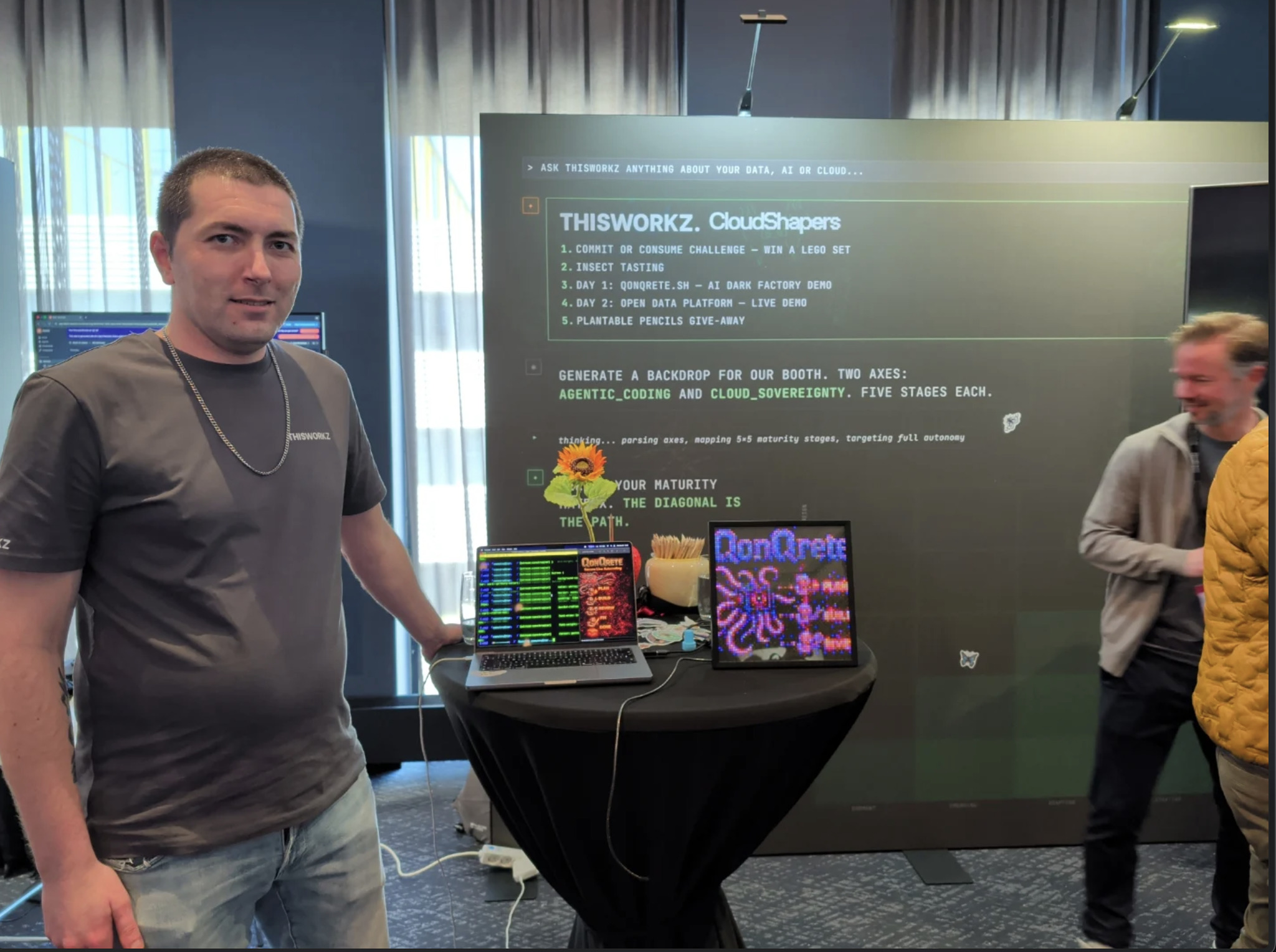
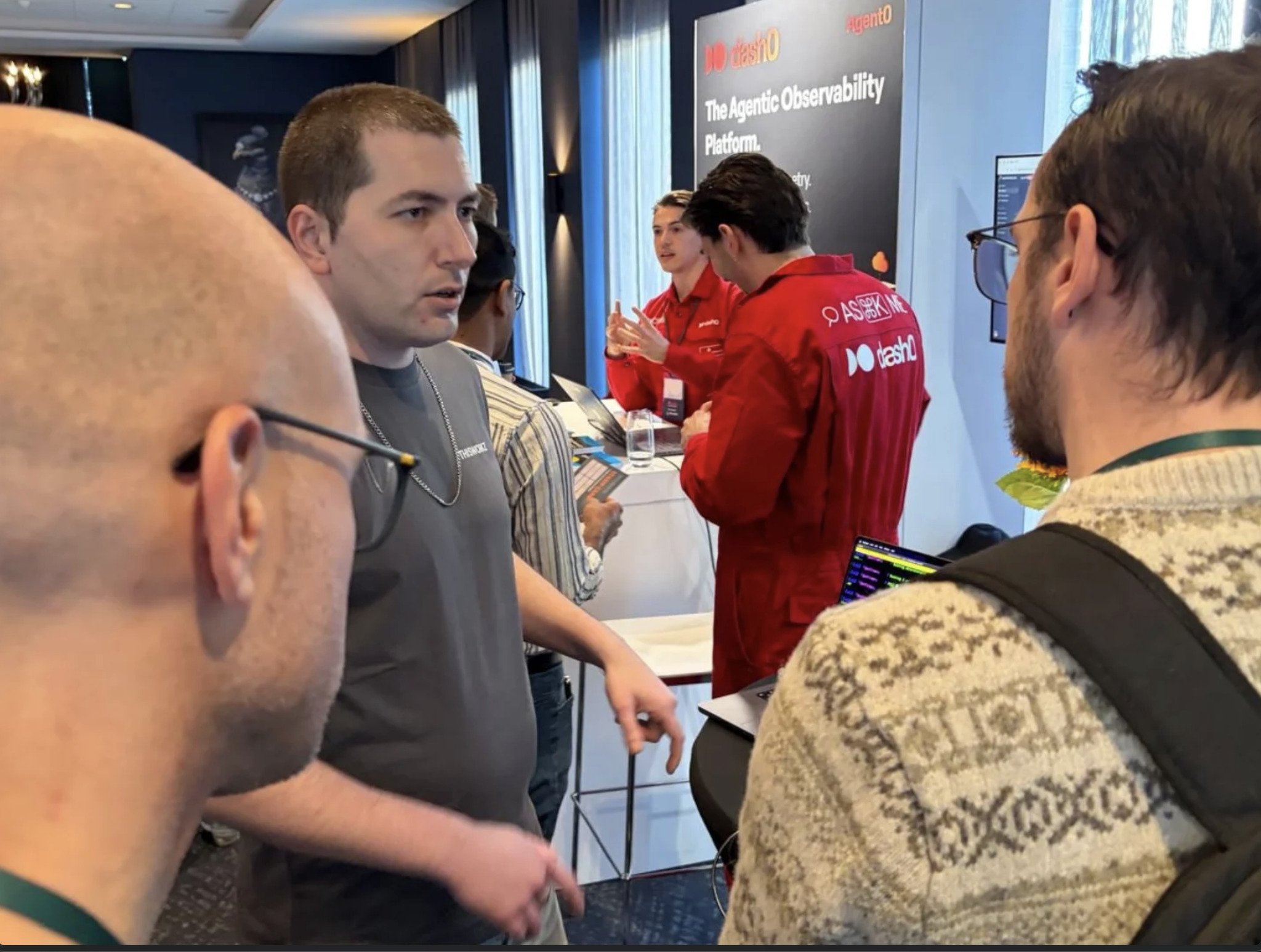
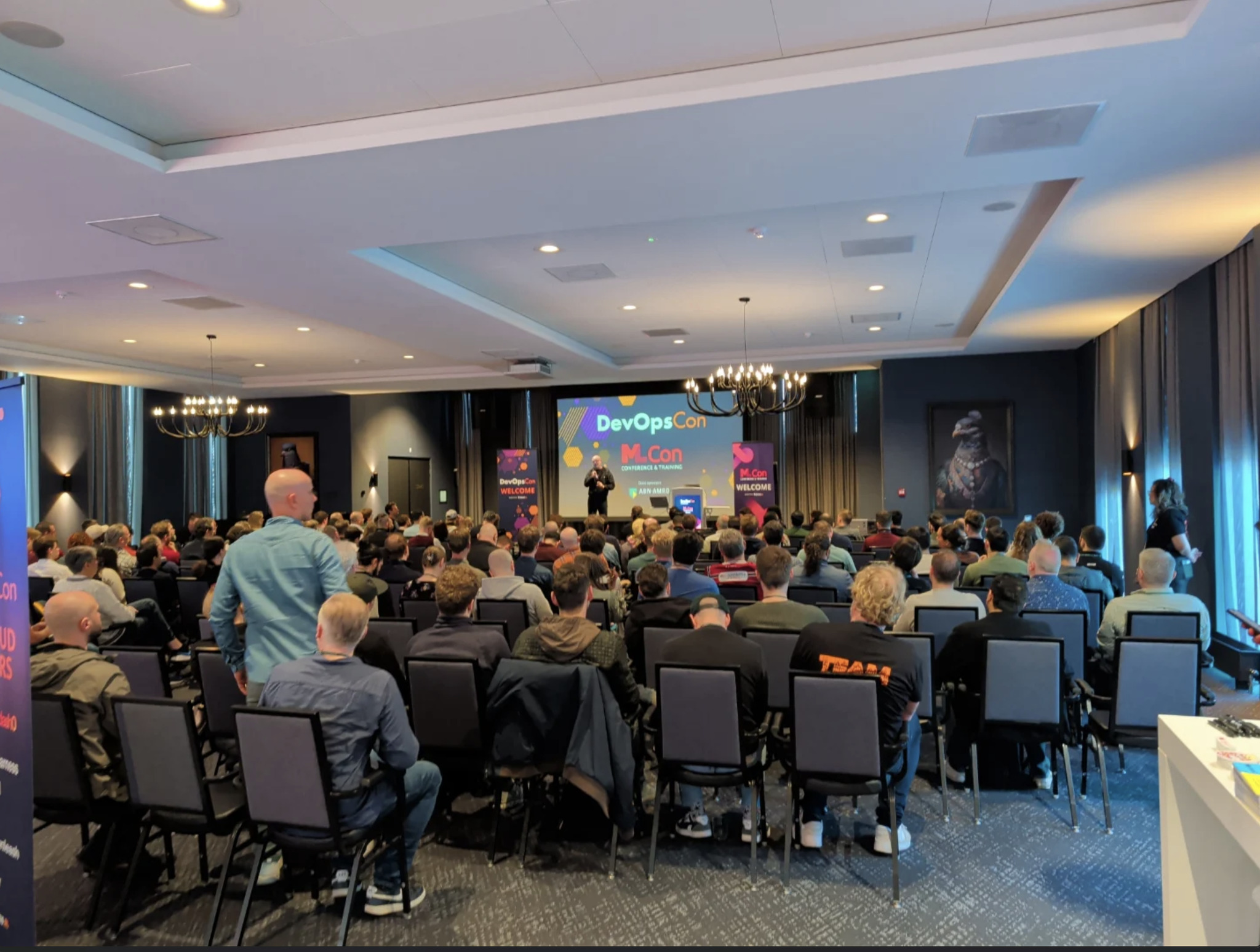
QonQrete joined DevOpsCon and MLCon 2026 at Van der Valk Hotel Amsterdam-Amstel, alongside Thisworkz, Dataworkz, Infraworkz, and Cloudshapers.
Booth setup
A self-brought Pixoo-64 displayed four looping GIFs — QonQrete, Thisworkz, Cloudshapers, and the neighboring challenge stand. That neighboring Thisworkz challenge was called Commit or Consume: visitors took technical challenges and won prizes (including a LEGO set). Fail and they ate an actual bug. Weird, memorable, and very effective.
The Pixoo-64 and live raw medium run became natural attention magnets. People paused, looked, asked what was happening, and that opened the door to explain qages, bounded runs, inspection artifacts, and controlled sync behavior.
The model-flex moment
During live demo throughput, quota burned too quickly because ConstruQtor was still configured with a high-end model profile. Instead of hiding it, the switch was done openly on the spot to deepseek-v3.2 through provider Venice for ongoing live medium runs. Got a laugh, but also made the point: model choice is contextual, budget matters during sustained demos, and process control is the differentiator.
The strategic gap in the room
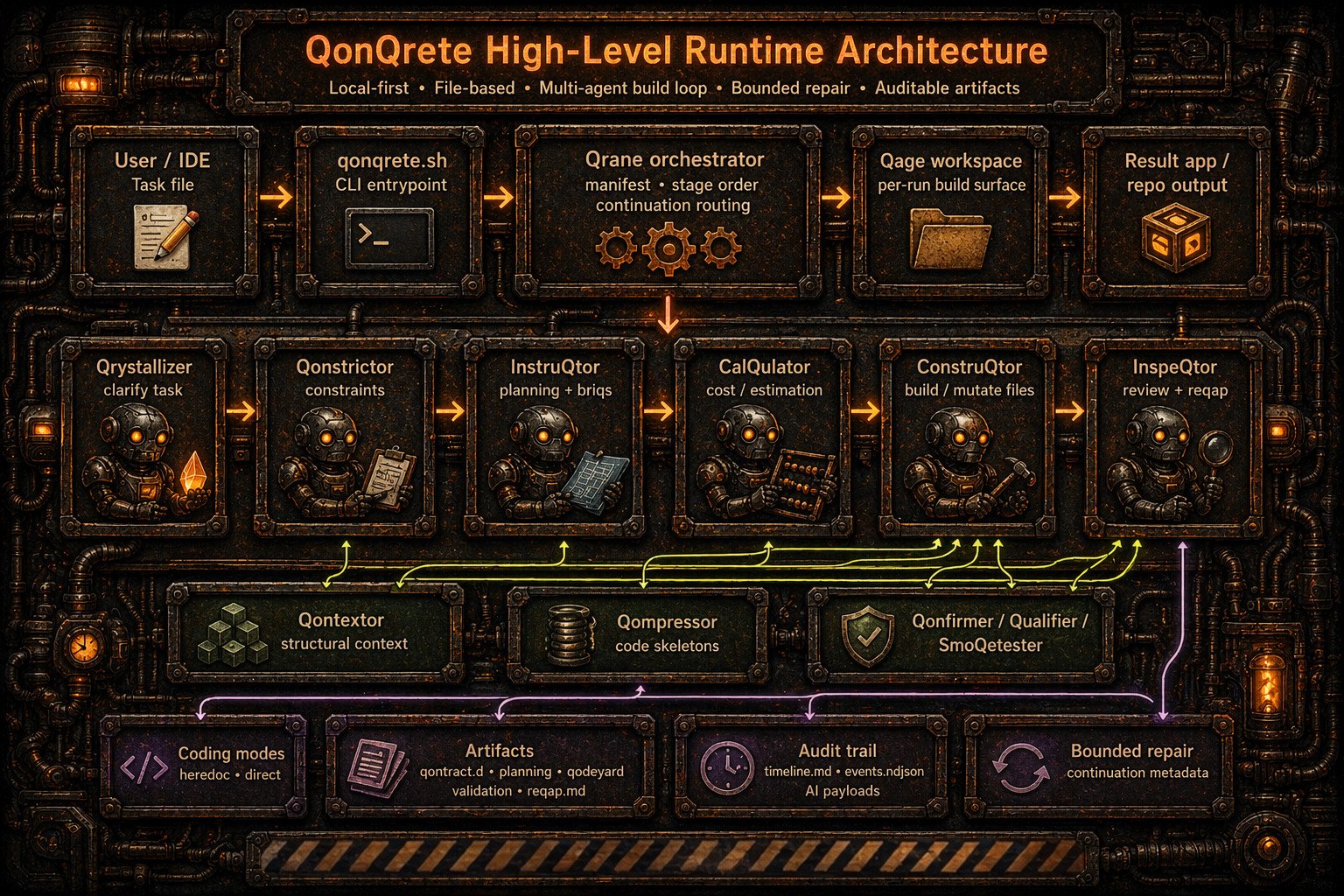
Most AI coding demos still fit one of two buckets: generation (“here is code”) or post-validation (“scan the result after coding”). QonQrete sits in a third bucket: execution orchestration. The run itself is structured — clarify, constrain, plan, build, validate, inspect, repair within limits, then decide what to sync. That upstream process layer resonated with people thinking about enterprise delivery, regulated workflows, auditability, failure containment, and local-first strategies.
The strongest message
Do not blindly trust the AI. Control the process. QonQrete’s qage-based workflow is built around bounded autonomy: isolated run area, inspectable artifacts, bounded repair logic, validation during execution, and controlled sync decisions. Not perfect safety claims. Just a workflow designed to make risky behavior easier to catch before it contaminates the main repo.
Local models solve where. QonQrete solves how.
Part 3: Post-Conference Hardening (v1.4.1 → v2.0.1)
After MLCon, the focus shifted from demo-readiness to production-readiness across six patch releases, now consolidated into v2.0.1.
v1.4.1 — Provider Alignment & Responsiveness
- Venice / deepseek-v3.2 primary default with improved fallback handling
- Install yard responsiveness: better scaling on narrow viewports, ticket/bay layout improvements
- Asset pipeline: updated homepage hero logo, simplified image asset layout
- CSS cleanup for IDE widgets grid on small screens
v1.4.3 — IntelliJ Compatibility Fixes
- Fixed plugin compatibility with all IntelliJ-based IDEs: IDEA, PyCharm, WebStorm, GoLand, CLion, RubyMine, Rider, DataGrip, PhpStorm
- Resolved class loading issues on older 2023.x IDE builds
- Fixed
NoClassDefFoundErrorforProgressManageron certain JetBrains runtime versions - Corrected
PluginExceptionon startup for fresh installations - Verified against IntelliJ Platform 2023.2 through 2026.1
- Improved error messaging for provider configuration mismatches
- Updated homepage hero logo
v1.4.4 — Runtime Versioning & Installer Hygiene
- Canonical
VERSIONfile at repo root as single source of truth qonqrete.shreadsQONQ_VERSIONfrom VERSION (fail-loud on missing/empty)- The single install.sh at repo root is the source of truth, copied directly into the nginx image
- Versioned release archive
qonqrete-v1.4.4.zipcreated
v1.4.5 — License Change & IntelliJ Polish
v1.4.6 — Core Runtime Fixes, DeepSeek V4, Plugin Verifier Zero-Warnings
-
Fedora SELinux permission fix: Rootless Podman on SELinux-enforcing hosts (Fedora, RHEL) could not write to the bind-mounted workspace. Fixed with
--security-opt label=disablefor rootless Podman on Linux. The container remains fully constrained by user namespace isolation,--cap-drop=ALL,--no-new-privileges, and--read-onlyrootfs. -
Interleaved validation cross-briq deferral: During multi-briq builds, the scoped qualifier would flag cross-scope file references as “missing” when they hadn’t been created yet. Fixed: cross-scope missing file references are deferred to the full deterministic validation pass.
-
DeepSeek V4 model upgrade: Default models upgraded from legacy
deepseek-chat/deepseek-reasonertodeepseek-v4-flash,deepseek-v4-flash-thinking,deepseek-v4-pro,deepseek-v4-pro-thinking. Updated across the entire stack: model capabilities, pricing, installer, VS Code extension, IntelliJ plugin, and documentation. Legacy aliases retained for backward compat. -
IntelliJ Plugin Verifier — Zero Warnings: Clean bill across 2023.3–2026.2 EAP. 0 scheduled-for-removal, 0 override-only, 0 deprecated, 0 internal API violations.
-
LICENSE updated
-
Additional IntelliJ plugin edge-case fixes
-
All version references consolidated across the codebase
-
Homepage hero refreshed from repo-root
qonqrete.jpg
v2.0.1 — IntelliJ 253+ Baseline, IDE UX Alignment & Full Parity
- IntelliJ Platform 233 → 253+: Minimum IDE version raised to 2025.3 (build 253), Java target 17 → 21, Kotlin 1.9.21 → 2.0.21.
- All deprecated API warnings resolved:
createFromInputEvent(),update()override-only,CredentialAttributes3-param — all gone. Plugin Verifier clean across full 9-version matrix. - IntelliJ UX fixes: Init button runs from project root, first-launch dialog crash fixed, qonstruction name prompt made conditional on
noSync. - VS Code ↔ IntelliJ full alignment: Defaults synced (sensitivity 1, cycles 1, noSync false, useSqrapyard true). Provider lists matched, DeepSeek models matched, OpenRouter references fixed, tasq.md templates identical.
- VS Code fixes:
noSyncdefault changed from true to false, qonstruction name prompt made conditional.
Why This Matters
v2.0.1 MLCon Edition captures the full arc: the pre-conference sprint, the live demo validation on the conference floor, and the post-conference hardening that turned a demo build into a production release. The IntelliJ plugin now works reliably across the full JetBrains ecosystem, the install pipeline is version-consistent from top to bottom, and the controlled execution story that landed at MLCon is now backed by five rounds of post-conference polish, plus a production-hardened v2.0.1 with IntelliJ 253+ and full IDE feature parity.
Do not blindly trust the AI. Control the process.
— RikkeTik